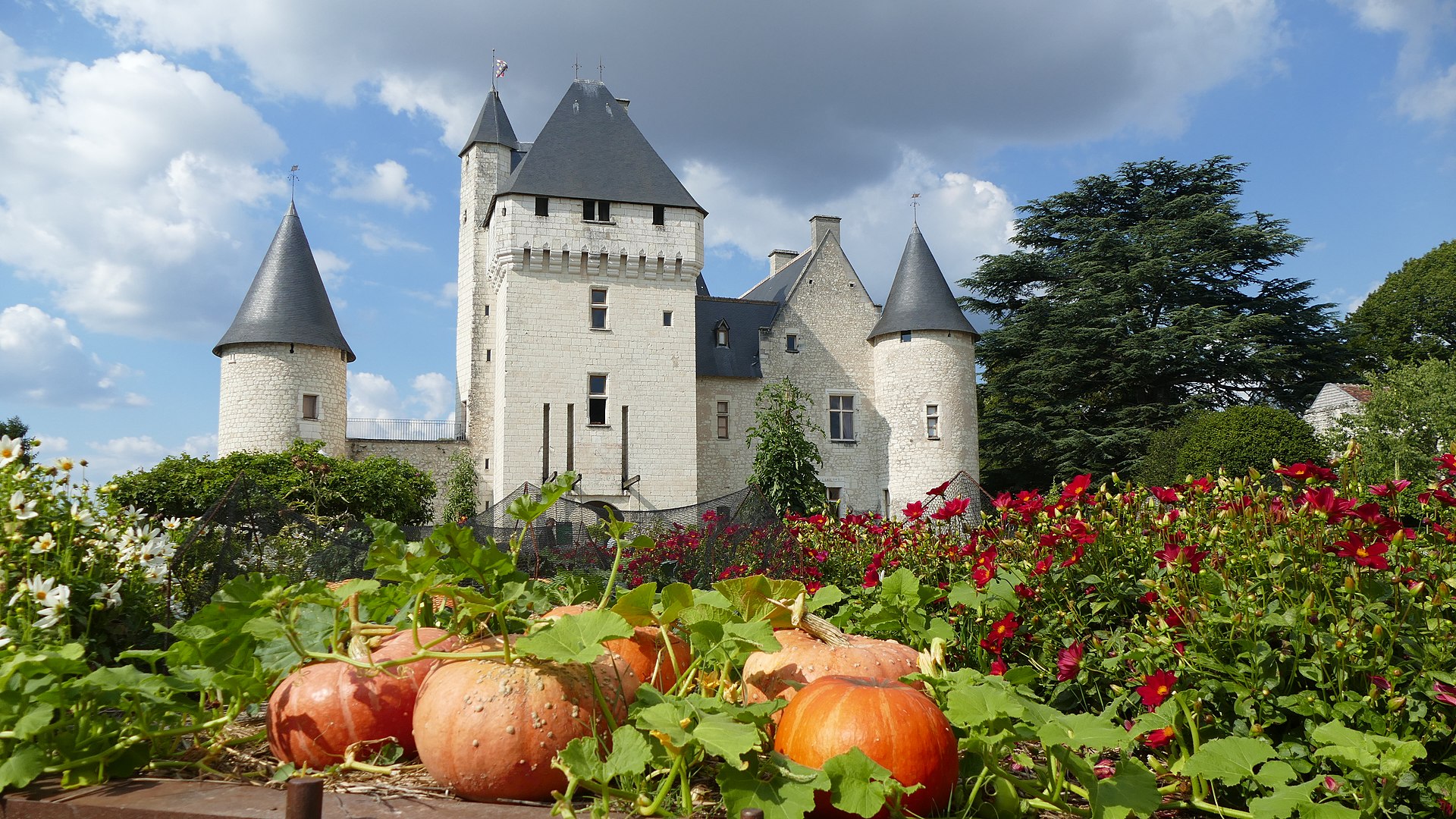
A fortified residence near Chinon, where a medieval silhouette, Renaissance stables and contemporary garden life remain in close conversation.
Lémeré · XIII–XVIII · Château
The façade of Château du Rivau seen from its vegetable conservatory.Image — Aliasse16 / Wikimedia Commons CC BY-SA 4.0 · Source
Château du Rivau stands at Lémeré, near Chinon in Indre-et-Loire. The estate’s history describes a fifteenth-century fortified residence built on the foundations of an earlier fortified house. The ensemble includes the château, Renaissance royal stables, a barn and a wine press. Restoration by the Laigneau family has accompanied the development of gardens and a programme of contemporary art. The current gardens are the work of Patricia Laigneau and are organised into distinct botanical and narrative spaces. These modern activities should be distinguished from the dating of the surviving buildings. Rivau combines architectural heritage with an actively maintained landscape; its gardens are neither incidental decoration nor evidence of a wholly surviving medieval planting scheme.
Record
Country
France
Department
Indre-et-Loire
Municipality
Lémeré
Centuries
XIII–XVIII
Style
Renaissance
Protection
Monument historique — classé
Reference
PA00097802
Editorial reading
## Fortification and present use
The château’s towers and compact mass provide the first impression, but the visit gains depth when the outbuildings enter the picture. Stables and agricultural structures widen the story beyond the residence itself. They suggest an estate organised around several kinds of work and movement.
The contemporary gardens and art introduce a different temporal layer. Rather than treating them as distractions from the medieval building, notice how they direct the approach and change the experience of the walls. Rivau offers a useful contrast with the larger royal residences: the relationship between building, planted space and current stewardship is particularly close and visible.
Recommendation
Check the estate’s current ticket, opening programme and accessible routes, then plan time for both the château and the grounds. Read the main building first from the approach and garden before entering the available rooms. Ask which outbuildings and exhibitions form part of the visit on your date. Do not assume that hotel, restaurant or event access is included in monument admission. Combine Rivau with a separate walk in Chinon or a village stop rather than compressing several distant castles into the same day.
From the register
Ce château est construit sur une colline le long de la vallée de la Veude. Bâti aux 13e et 14e siècles, il a été reconstruit d’un jet au cours des années 1450 pour Pierre de Beauvau, seigneur de la Roche-sur-Yon, gouverneur d’Anjou et du Maine. Les communs au sud du château ont été édifiés au 16e siècle (probablement dans la seconde moitié). Les bâtiments sont disposés en U autour d’une cour quadrangulaire. Trois tours marquent les angles. L’aile ouest est occupée par des écuries, tandis qu’à l’est se trouve la grange du 18e siècle. Les anciennes écuries voûtées de pierre dans un vaste bâtiment en L avaient des mangeoires en pierre de taille (pour la plupart détruites). Dans la cour, on remarque une fontaine du 17e siècle, composée d’un bassin à huit pans et d’un massif rectangulaire surmonté d’un couronnement sculpté.
Quoted from Base Mérimée — immeubles protégés, unedited.
Val de Loire·Regional Editorial Collection
The Loire — A Landscape of Power, Gardens & River Life
An extraordinary contemporary botanical achievement, proving that medieval military ruins can host imaginative modern garden poetry.
Forteresse royale de Chinon is a château at Chinon, Indre-et-Loire, in the Centre-Val de Loire region of France. The recorded building campaigns date from the 14th and 15th centuries. It is protected as a monument historique at the higher of the two levels (classé). Details are drawn from the Base Mérimée of the French Ministry of Culture.
Crissay-sur-Manse lies in Indre-et-Loire, in the valley of the Manse. Tuffeau houses give the village the pale masonry characteristic of Touraine. The architectural ensemble includes the remains of a château with medieval origins and the church of Saint-Maurice, dating from the sixteenth century. Houses and carved openings record the Renaissance character of the settlement. The village is a member of Les Plus Beaux Villages de France. Its small scale allows the church, residential streets, château remains and valley setting to be read together. The château is a separate property, so the presence of ruins in the village does not imply unrestricted access to them.